> ## Documentation Index
> Fetch the complete documentation index at: https://signalpilot.ai/docs/llms.txt
> Use this file to discover all available pages before exploring further.
# How SignalPilot Works
> Deep dive into the 4 foundational systems that make up the agentic harness for AI-forward data teams
## How the Agentic Harness Works
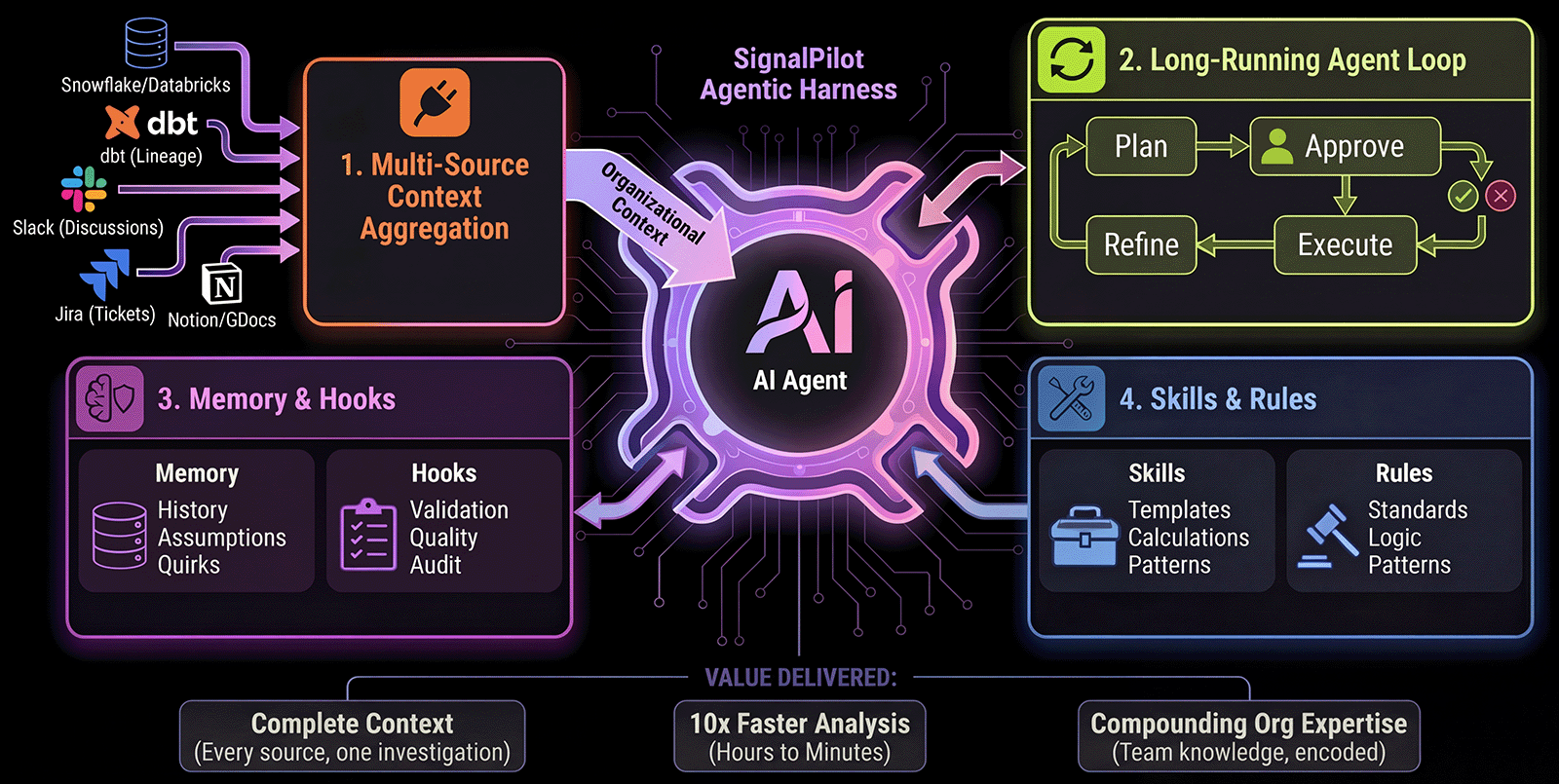
SignalPilot is built on **4 foundational systems** that work together to enable AI agents for data investigation — while keeping analysts in control.
 ***
## Four Foundational Systems
SignalPilot connects to your data stack via internal explorer and context orchestraton tools, jupyter notebook interface, and **MCP (Model Context Protocol):**
**Internal Context Explorer:**
* Kernel operations (execute code, introspect state)
* Database queries (schemas, performance, history)
* Schema introspection (metadata, lineage)
* Kernel variables (dataframes, active data)
* Local files (notebooks, CSVs, configs)
**External MCP Servers:**
* **dbt** (Cloud/Core): Model lineage, documentation, tests
* **Slack**: Threads, decisions, discussions about data
* **Jira**: Tickets, issues, deployment history
* **GDocs/Notion**: Design docs, wikis, runbooks
* **Snowflake/Databricks**: Query logs, usage stats
**Result:** The AI can reason across your entire data stack + organizational knowledge.
Understand how MCP enables context orchestration
Unlike single-shot completions (ChatGPT) or auto-apply copilots, SignalPilot runs a **long-running investigation loop with human oversight:**
```
1. Resolve Contexts (PARALLEL)
└─ Fetch schemas, lineage, Slack threads, query history, past investigations
2. Build System Prompt (with full organizational context)
3. Generate Investigation Plan
└─ AI proposes multi-step approach
4. 👤 ANALYST APPROVAL CHECKPOINT
└─ Review plan, modify, or reject before execution
5. Execute Tools (PARALLEL)
└─ Run queries, update cells, generate plots, check assumptions
6. Stream Results + Continuous Completion Check
└─ Loop until investigation complete or analyst stops
7. Save to Memory
└─ Capture findings, validated assumptions, patterns for future investigations
```
**Why "long-running"?** Data investigations aren't single queries — they're multi-step processes. SignalPilot maintains context across the entire investigation.
**Why "analyst-in-the-loop"?** You approve plans before execution. AI proposes, you decide. Full control with AI assistance.
How the production loop works internally
**Multi-Session Memory** is the institutional knowledge layer that makes AI agents actually useful:
* **Analysis history:** What hypotheses were tested in past investigations? What was ruled out?
* **Validated assumptions:** "Revenue calculation uses net, not gross" (learned once, applied forever)
* **Known data quirks:** "Orders table has duplicates before 2024-01" (no more rediscovering issues)
* **Past solutions:** "Last time conversion spiked, it was timezone issues" (pattern recognition)
**Why this matters:** Without memory, every investigation starts from zero. With memory, SignalPilot learns your data stack over time.
***
**Control Hooks** are safety guardrails that enforce governance and best practices:
* **Pre-execution validation:** "Only query prod DB during office hours" (prevent accidents)
* **Data quality checks:** "Warn if row count changed >20%" (catch anomalies early)
* **Custom constraints:** "Always use vectorized pandas, never iterrows()" (enforce performance patterns)
* **Audit logging:** Track what data was accessed, when, and for what investigation (compliance-ready)
**Why this matters:** Agentic systems need constraints. Hooks let you define boundaries while still enabling autonomy.
How memory works and what gets stored
Custom constraints and validations
**Custom Skills** are reusable analysis patterns that encode your team's domain expertise:
* **Analysis templates:** "Run cohort retention on users table with our 7-day/30-day windows"
* **Domain calculations:** "Calculate MRR using our billing logic: (seats × price) + overages - credits"
* **Data transformations:** "Clean customer addresses using USPS standards + international normalization"
* **Visualization templates:** "Generate exec-ready revenue waterfall using company brand colors"
**Why this matters:** Generic AI doesn't know your business. Skills let you teach SignalPilot your team's analysis playbook — once. Then every analyst benefits.
***
**Rules** are the coding standards and business logic that ensure consistency:
* **Code style:** "Always import pandas as pd, use type hints, docstrings for functions >10 lines"
* **Performance patterns:** "Use vectorized operations, never .iterrows(), always explain() queries before large scans"
* **Business logic:** "Revenue = (price × quantity) - discounts, EXCLUDE test\_accounts and internal domains"
* **Data quality gates:** "Flag if nulls >5%, dates outside \[2020, today], or row count Δ >20%"
**Why this matters:** Agentic harness means the infrastructure enforces your standards. No more "AI wrote bad code" — Rules prevent it from happening.
**Result:** Every analysis follows your team's best practices automatically. New analysts get instant access to senior patterns.
Build reusable analysis patterns
Enforce standards and business logic
***
## Why These 4 Systems Make an "Agentic Harness"
The harness metaphor is intentional — just like a climbing harness provides **infrastructure that keeps you safe while enabling you to climb higher**, SignalPilot provides the infrastructure that lets AI agents work on complex data investigations while keeping analysts in control:
1. **Context Layer (MCP)** → Gives AI the organizational knowledge to reason effectively
2. **Long-Running Loop** → Enables multi-step investigations (not single-shot queries) with human oversight
3. **Memory & Hooks** → Learns from past work + enforces safety boundaries
4. **Skills & Rules** → Customizes to your domain + coding standards
**Together:** AI-forward data teams get the speed of AI with the control, safety, and domain expertise they need for production investigations.
***
## Real-World Example: All 4 Systems Working Together
**Scenario:** Your CFO asks "Why did our conversion rate drop 8% last week?"
### Traditional Workflow (2+ hours, no institutional knowledge capture)
1. ⏱️ Open Snowflake, manually explore tables (no context)
2. ⏱️ Copy schema to ChatGPT, ask for query (hallucinated table names)
3. ⏱️ Run query, fix errors, re-run (3-4 iterations)
4. ⏱️ Check Slack for recent changes (scroll back 100+ messages manually)
5. ⏱️ Find Jira ticket about A/B test, read linked doc (manual search)
6. ⏱️ Write new queries based on findings (no memory of what was tested)
7. ⏱️ Create visualization in notebook (generic, not following team standards)
8. ⏱️ Write summary, **forget to document assumptions for next time**
### SignalPilot Agentic Harness (10 minutes, with learning)
**Ask once:** "Why did conversion rate drop 8% last week?"
**SignalPilot orchestrates using all 4 systems:**
#### 1. 🔌 Context Aggregation (System 1)
* Fetches Snowflake schema (conversion\_rate table, relationships)
* Loads dbt lineage (upstream dependencies: events → sessions → conversions)
* Searches Slack for "conversion" mentions last week → finds A/B test thread
* Pulls Jira ticket #3421 about experiment + linked design doc
* Queries Snowflake query\_history for anomalies
#### 2. 🔄 Long-Running Loop (System 2)
* **Generates investigation plan:** "Check A/B test deployment → Compare cohorts → Analyze funnel drop-off"
* **👤 Shows you plan for approval** (analyst-in-the-loop)
* You approve → Executes in phases:
* Phase 1: Validate A/B test started on drop date ✓
* Phase 2: Compare treatment vs control conversion ✓
* Phase 3: Identify funnel stage with issue ✓
#### 3. 🧠 Memory & Hooks (System 3)
* **Memory recalls:** "Last time conversion dropped (2 months ago), it was timezone bug in tracking"
* **Checks that pattern first** → Not the issue this time
* **Hooks enforce:** Data quality check flags that test group has 18% fewer users than control (suspicious)
* **Saves to memory:** "Conversion drops often correlate with A/B tests — check experiment metadata first"
#### 4. 💻 Skills & Rules (System 4)
* **Applies team skill:** "conversion\_funnel\_analysis" (your pre-built analysis template)
* **Follows rules:** Uses vectorized pandas (not loops), excludes test\_accounts, generates waterfall chart with brand colors
* **Enforces business logic:** Revenue calculation follows your formula (excludes refunds, includes discounts)
### Outcome
* ✅ Root cause identified: A/B test deployed with buggy tracking pixel
* ✅ Before/after comparison chart (following team viz standards)
* ✅ **Institutional knowledge captured:** "Check A/B test experiments first for conversion anomalies"
* ✅ **Next analyst who investigates conversion** gets this pattern automatically
**Time saved:** 2 hours → 10 minutes
**Knowledge multiplier:** Every investigation makes the team smarter
Debug a revenue drop in 5 minutes (step-by-step)
***
## Next Steps
See full comparison vs ChatGPT and IDE copilots
Read-only access, zero retention, audit trail
5-minute walkthrough with your data
Understand agents, modes, planning, and context
***
## Four Foundational Systems
SignalPilot connects to your data stack via internal explorer and context orchestraton tools, jupyter notebook interface, and **MCP (Model Context Protocol):**
**Internal Context Explorer:**
* Kernel operations (execute code, introspect state)
* Database queries (schemas, performance, history)
* Schema introspection (metadata, lineage)
* Kernel variables (dataframes, active data)
* Local files (notebooks, CSVs, configs)
**External MCP Servers:**
* **dbt** (Cloud/Core): Model lineage, documentation, tests
* **Slack**: Threads, decisions, discussions about data
* **Jira**: Tickets, issues, deployment history
* **GDocs/Notion**: Design docs, wikis, runbooks
* **Snowflake/Databricks**: Query logs, usage stats
**Result:** The AI can reason across your entire data stack + organizational knowledge.
Understand how MCP enables context orchestration
Unlike single-shot completions (ChatGPT) or auto-apply copilots, SignalPilot runs a **long-running investigation loop with human oversight:**
```
1. Resolve Contexts (PARALLEL)
└─ Fetch schemas, lineage, Slack threads, query history, past investigations
2. Build System Prompt (with full organizational context)
3. Generate Investigation Plan
└─ AI proposes multi-step approach
4. 👤 ANALYST APPROVAL CHECKPOINT
└─ Review plan, modify, or reject before execution
5. Execute Tools (PARALLEL)
└─ Run queries, update cells, generate plots, check assumptions
6. Stream Results + Continuous Completion Check
└─ Loop until investigation complete or analyst stops
7. Save to Memory
└─ Capture findings, validated assumptions, patterns for future investigations
```
**Why "long-running"?** Data investigations aren't single queries — they're multi-step processes. SignalPilot maintains context across the entire investigation.
**Why "analyst-in-the-loop"?** You approve plans before execution. AI proposes, you decide. Full control with AI assistance.
How the production loop works internally
**Multi-Session Memory** is the institutional knowledge layer that makes AI agents actually useful:
* **Analysis history:** What hypotheses were tested in past investigations? What was ruled out?
* **Validated assumptions:** "Revenue calculation uses net, not gross" (learned once, applied forever)
* **Known data quirks:** "Orders table has duplicates before 2024-01" (no more rediscovering issues)
* **Past solutions:** "Last time conversion spiked, it was timezone issues" (pattern recognition)
**Why this matters:** Without memory, every investigation starts from zero. With memory, SignalPilot learns your data stack over time.
***
**Control Hooks** are safety guardrails that enforce governance and best practices:
* **Pre-execution validation:** "Only query prod DB during office hours" (prevent accidents)
* **Data quality checks:** "Warn if row count changed >20%" (catch anomalies early)
* **Custom constraints:** "Always use vectorized pandas, never iterrows()" (enforce performance patterns)
* **Audit logging:** Track what data was accessed, when, and for what investigation (compliance-ready)
**Why this matters:** Agentic systems need constraints. Hooks let you define boundaries while still enabling autonomy.
How memory works and what gets stored
Custom constraints and validations
**Custom Skills** are reusable analysis patterns that encode your team's domain expertise:
* **Analysis templates:** "Run cohort retention on users table with our 7-day/30-day windows"
* **Domain calculations:** "Calculate MRR using our billing logic: (seats × price) + overages - credits"
* **Data transformations:** "Clean customer addresses using USPS standards + international normalization"
* **Visualization templates:** "Generate exec-ready revenue waterfall using company brand colors"
**Why this matters:** Generic AI doesn't know your business. Skills let you teach SignalPilot your team's analysis playbook — once. Then every analyst benefits.
***
**Rules** are the coding standards and business logic that ensure consistency:
* **Code style:** "Always import pandas as pd, use type hints, docstrings for functions >10 lines"
* **Performance patterns:** "Use vectorized operations, never .iterrows(), always explain() queries before large scans"
* **Business logic:** "Revenue = (price × quantity) - discounts, EXCLUDE test\_accounts and internal domains"
* **Data quality gates:** "Flag if nulls >5%, dates outside \[2020, today], or row count Δ >20%"
**Why this matters:** Agentic harness means the infrastructure enforces your standards. No more "AI wrote bad code" — Rules prevent it from happening.
**Result:** Every analysis follows your team's best practices automatically. New analysts get instant access to senior patterns.
Build reusable analysis patterns
Enforce standards and business logic
***
## Why These 4 Systems Make an "Agentic Harness"
The harness metaphor is intentional — just like a climbing harness provides **infrastructure that keeps you safe while enabling you to climb higher**, SignalPilot provides the infrastructure that lets AI agents work on complex data investigations while keeping analysts in control:
1. **Context Layer (MCP)** → Gives AI the organizational knowledge to reason effectively
2. **Long-Running Loop** → Enables multi-step investigations (not single-shot queries) with human oversight
3. **Memory & Hooks** → Learns from past work + enforces safety boundaries
4. **Skills & Rules** → Customizes to your domain + coding standards
**Together:** AI-forward data teams get the speed of AI with the control, safety, and domain expertise they need for production investigations.
***
## Real-World Example: All 4 Systems Working Together
**Scenario:** Your CFO asks "Why did our conversion rate drop 8% last week?"
### Traditional Workflow (2+ hours, no institutional knowledge capture)
1. ⏱️ Open Snowflake, manually explore tables (no context)
2. ⏱️ Copy schema to ChatGPT, ask for query (hallucinated table names)
3. ⏱️ Run query, fix errors, re-run (3-4 iterations)
4. ⏱️ Check Slack for recent changes (scroll back 100+ messages manually)
5. ⏱️ Find Jira ticket about A/B test, read linked doc (manual search)
6. ⏱️ Write new queries based on findings (no memory of what was tested)
7. ⏱️ Create visualization in notebook (generic, not following team standards)
8. ⏱️ Write summary, **forget to document assumptions for next time**
### SignalPilot Agentic Harness (10 minutes, with learning)
**Ask once:** "Why did conversion rate drop 8% last week?"
**SignalPilot orchestrates using all 4 systems:**
#### 1. 🔌 Context Aggregation (System 1)
* Fetches Snowflake schema (conversion\_rate table, relationships)
* Loads dbt lineage (upstream dependencies: events → sessions → conversions)
* Searches Slack for "conversion" mentions last week → finds A/B test thread
* Pulls Jira ticket #3421 about experiment + linked design doc
* Queries Snowflake query\_history for anomalies
#### 2. 🔄 Long-Running Loop (System 2)
* **Generates investigation plan:** "Check A/B test deployment → Compare cohorts → Analyze funnel drop-off"
* **👤 Shows you plan for approval** (analyst-in-the-loop)
* You approve → Executes in phases:
* Phase 1: Validate A/B test started on drop date ✓
* Phase 2: Compare treatment vs control conversion ✓
* Phase 3: Identify funnel stage with issue ✓
#### 3. 🧠 Memory & Hooks (System 3)
* **Memory recalls:** "Last time conversion dropped (2 months ago), it was timezone bug in tracking"
* **Checks that pattern first** → Not the issue this time
* **Hooks enforce:** Data quality check flags that test group has 18% fewer users than control (suspicious)
* **Saves to memory:** "Conversion drops often correlate with A/B tests — check experiment metadata first"
#### 4. 💻 Skills & Rules (System 4)
* **Applies team skill:** "conversion\_funnel\_analysis" (your pre-built analysis template)
* **Follows rules:** Uses vectorized pandas (not loops), excludes test\_accounts, generates waterfall chart with brand colors
* **Enforces business logic:** Revenue calculation follows your formula (excludes refunds, includes discounts)
### Outcome
* ✅ Root cause identified: A/B test deployed with buggy tracking pixel
* ✅ Before/after comparison chart (following team viz standards)
* ✅ **Institutional knowledge captured:** "Check A/B test experiments first for conversion anomalies"
* ✅ **Next analyst who investigates conversion** gets this pattern automatically
**Time saved:** 2 hours → 10 minutes
**Knowledge multiplier:** Every investigation makes the team smarter
Debug a revenue drop in 5 minutes (step-by-step)
***
## Next Steps
See full comparison vs ChatGPT and IDE copilots
Read-only access, zero retention, audit trail
5-minute walkthrough with your data
Understand agents, modes, planning, and context